
Active listening skills are the backbone of effective communication in today’s fast-paced world. In professional and personal interactions alike, true listening goes beyond hearing words—it involves understanding intent, emotions, and meaning. By focusing on understanding rather than responding, individuals can improve clarity, trust, emotional intelligence, and professional success. Mastering active listening skills leads to better conversations, stronger relationships, and more impactful leadership.
This article explores how active listening improves clarity, trust, collaboration, and decision-making across workplaces and relationships. This in-depth guide explains what it truly means, why it matters in professional communication, and how mastering it improves leadership, relationships, and workplace success—using practical active listening techniques and real examples.
What Is Active Listening Skill?
Active listening is the conscious practice of fully focusing on a speaker to understand their message, emotions, and intent without interruption or judgment. Unlike passive hearing, active listening requires attention, empathy, and thoughtful responses. It ensures conversations are meaningful, reduces misunderstandings, and builds stronger interpersonal connections in both professional and personal settings.
Listening vs Active Listening: Difference
Listening is passive—you hear words while planning your response. Active listening is participative—you focus on understanding before reacting.
Active listeners observe tone, facial expressions, and emotional cues. They ask clarifying questions and reflect key points to confirm understanding. This difference is critical in professional environments where clarity and trust directly impact outcomes. So, the difference lies in engagement and intent.
Why It Matters
- Reduces assumptions and misinterpretation
- Improves response quality
- Encourages open dialogue
- Enhances emotional intelligence
Micro-example:
Instead of replying immediately in a meeting, an active listener asks, “Can you clarify what success looks like here?”
Summary: Active listening prioritizes understanding over responding.

Importance of Active Listening Skills in Communication
Active listening skills go beyond simply hearing words. They involve fully concentrating, understanding, responding, and remembering what is being communicated. In professional and personal interactions alike, it ensures that messages are received accurately and intentions are clearly understood.
Unlike passive listening—where attention drifts or responses are automatic—active listening is intentional. It requires mental presence, emotional awareness, and verbal feedback. In today’s distraction-heavy environment, active listening has become a high-value communication skill that separates effective professionals from average communicators.
Why It Matters
- Prevents misunderstandings before they escalate
- Builds mutual respect and psychological safety
- Improves collaboration and productivity
- Strengthens leadership presence and credibility
- Encourages open and honest dialogue
Micro-example:
A manager who summarizes a team member’s concern before responding shows attentiveness and earns trust instantly. Instead of replying immediately, you paraphrase a colleague’s concern to confirm understanding.Summary: Active listening transforms conversations from transactional exchanges into meaningful communication.
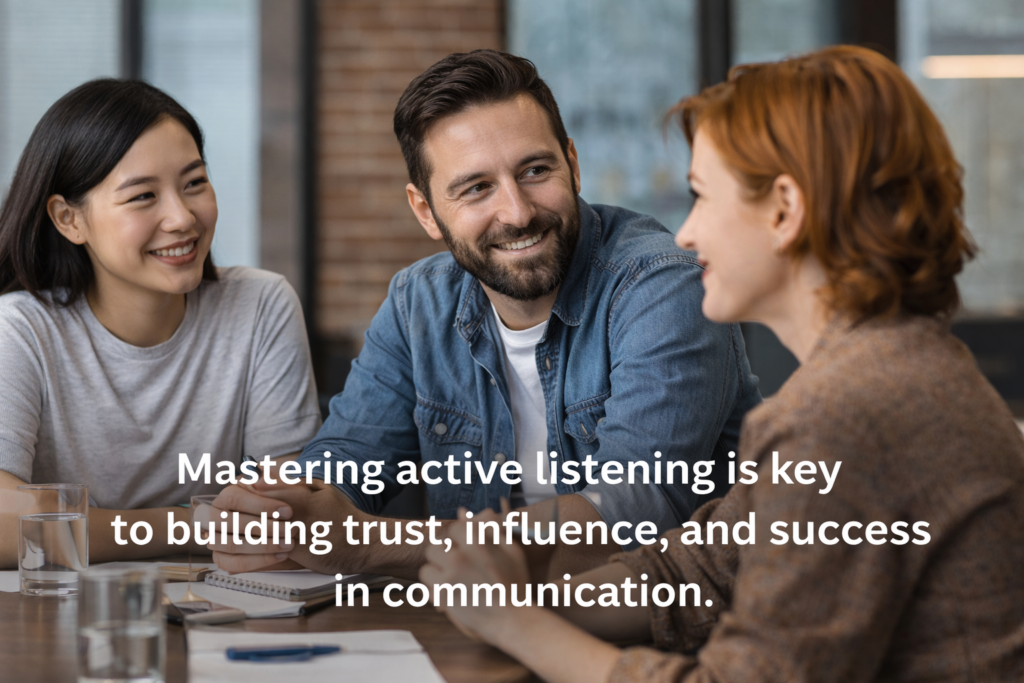
Why Active Listening Skills Are Essential in the Workplace
Modern workplaces thrive on collaboration, feedback, and cross-functional communication. Active listening ensures that ideas are exchanged clearly and teams stay aligned.
In performance reviews, meetings, negotiations, and brainstorming sessions, it helps professionals understand expectations and contribute effectively. It also reduces workplace friction caused by assumptions and miscommunication.
Why It Matters
- Improves team collaboration
- Enhances decision-making accuracy
- Reduces workplace conflict
- Boosts employee engagement
Micro-example:
An employee feels valued when their suggestion is acknowledged and built upon during meetings.
Summary:
Active listening is the foundation of healthy workplace communication skills.


Active Listening in Leadership Communication
Leadership is less about speaking and more about listening with intent. Leaders who actively listen gain deeper insights, make informed decisions, and inspire trust.
Active listening allows leaders to understand team challenges, read between the lines, and respond with empathy. It also signals humility—a key trait of respected leaders.
Why It Matters
- Builds trust and credibility
- Encourages innovation
- Strengthens team loyalty
- Improves leadership effectiveness
Micro-example:
A leader who listens without interrupting during feedback sessions earns long-term respect.
Summary:
Great leaders listen first, then lead with clarity.
Role of Active Listening in Workplace Communication
In professional environments, active listening directly impacts productivity, teamwork, and leadership effectiveness. When employees feel heard, engagement rises and conflicts reduce. Managers who practice active listening create inclusive cultures where ideas flow freely and decisions are better informed.
Why It Matters:
- Improves employee engagement
- Strengthens manager–employee relationships
- Enables clearer instructions and feedback
Micro-Example:
A manager listens fully before responding to a team member’s concern about deadlines.
Active Listening and Emotional Intelligence
Active listening is a critical component of emotional intelligence. It allows individuals to recognize emotions behind words and respond empathetically. This skill is especially valuable in high-stakes conversations, conflict resolution, and leadership roles where emotional awareness drives better outcomes.
Why It Matters:
- Enhances empathy and rapport
- De-escalates conflicts
- Improves interpersonal sensitivity
Micro-Example:
Acknowledging frustration in a client’s tone before addressing the issue.
Verbal and Non-Verbal Elements of Active Listening
Active listening combines verbal cues—such as clarifying questions and paraphrasing—with non-verbal signals like eye contact, posture, and facial expressions. These cues reassure the speaker that their message is being received and valued, strengthening communication effectiveness. [Read – Ways to Improve Verbal & Non-Verbal Communication Skills]
Why It Matters:
- Reinforces attentiveness
- Builds speaker confidence
- Encourages deeper dialogue
Micro-Example:
Maintaining eye contact and saying, “Let me make sure I understand…”
Key Components of Active Listening Skills
Active listening involves several interconnected skills that work together to ensure effective communication.
Core Elements
- Attention: Staying mentally present
- Observation: Reading non-verbal cues
- Understanding: Interpreting meaning accurately
- Response: Providing thoughtful feedback
- Retention: Remembering key points
Why It Matters
- Ensures message accuracy
- Prevents misalignment
- Enhances communication depth
Micro-example:
Taking notes during discussions improves retention and follow-up accuracy.
Summary:
Active listening is a combination of focus, empathy, and feedback.
Benefits of Active Listening in Personal & Professional Life
From stronger workplace collaboration to healthier personal relationships, active listening creates positive outcomes across life domains. It fosters trust, minimizes conflict, and ensures conversations lead to understanding rather than assumptions.
Why It Matters:
- Builds long-term relationships
- Enhances problem-solving
- Improves influence and persuasion
Micro-Example:
Listening fully before offering advice to a friend or colleague.
How to Improve Active Listening Skills
Active listening can be developed through consistent practice. Effective techniques include maintaining eye contact, reflective listening, paraphrasing, nodding for acknowledgment, and avoiding interruptions, asking open-ended questions, and summarizing key points to help listeners engage more deeply and respond more thoughtfully. Given below are the practical techniques to improve active listening skills
- Stay mentally present by removing distractions and focusing fully on the speaker
- Notice body language, tone, and facial expressions—not just words
- Maintain natural eye contact to show interest and respect
- Ask open-ended questions to encourage deeper sharing
- Reflect back key points to confirm understanding
- Listen patiently without interrupting or forming quick judgments
Active listening grows when attention, empathy, and curiosity work together—helping conversations feel meaningful, respectful, and productive.
Why It Matters
- Enhances conversational flow
- Improves response relevance
- Strengthens professional credibility
- Builds mutual respect
Micro-example:
Repeating key points confirms understanding and prevents errors.
Summary: Simple listening techniques create a powerful communication impact.

Common Barriers to Active Listening: How to Overcome Them
Despite good intentions, many professionals struggle with active listening due to internal and external barriers. Distractions, distractions, multitasking, emotional bias, premature judgment, assumptions, emotional bias, and the urge to respond quickly are common obstacles to active listening. Overcoming these barriers requires conscious effort and habit change. Recognizing these barriers is the first step toward overcoming them. Awareness allows individuals to consciously refocus and improve communication quality.
Why It Matters
- Improves communication clarity
- Reduces misunderstandings
- Helps eliminate listening blind spots
- Improves patience and focus
- Strengthens professional relationships
Micro-example:
Putting away phones during meetings significantly improves listening quality.
Summary: Removing listening barriers unlocks clearer communication.
Active Listening in Conflict Resolution
Conflicts often escalate due to misunderstandings rather than disagreements. Active listening allows all parties to feel heard before solutions are proposed.
By acknowledging emotions and clarifying intent, active listeners de-escalate tension and guide conversations toward resolution.
Why It Matters
- Reduces defensiveness
- Encourages compromise
- Preserves relationships
Micro-example:
Restating concerns before offering solutions diffuses emotional reactions.
Summary:
Active listening turns conflict into constructive dialogue.
Active Listening in Sales, Negotiation, and Client Communication
In sales and negotiations, listening often matters more than speaking. Understanding client needs, objections, and emotions enables tailored solutions.
Active listeners identify hidden concerns and build trust—key drivers of successful deals.
Why It Matters
- Improves conversion rates
- Builds long-term client trust
- Enhances negotiation outcomes
Micro-example:
Listening carefully to client objections leads to precise responses.
Summary: Active listening increases influence and closes better deals.
How Active Listening Improves Personal Relationships
Beyond professional settings, it strengthens personal connections. It fosters empathy, emotional bonding, and mutual respect.
When people feel genuinely heard, relationships deepen and communication becomes more open and honest.
Why It Matters
- Builds emotional intimacy
- Reduces misunderstandings
- Strengthens trust
Micro-example:
Listening without offering immediate advice shows emotional support.
Summary: Active listening nurtures stronger human connections.
Developing Active Listening as a Daily Habit
Like any skill, active listening improves with consistent practice. Making it a daily habit ensures long-term benefits.
Start small—focus on one conversation at a time, eliminate distractions, and reflect on listening quality after interactions.
Why It Matters
- Sustains communication improvement
- Builds long-term credibility
- Enhances emotional intelligence
Micro-example:
Reflecting on conversations helps identify listening gaps.
Summary: Daily listening habits shape long-term communication success.
How Active Listening Skills Drive Career Growth
Professionals who listen actively are perceived as reliable, empathetic, and competent. These traits accelerate career growth and leadership opportunities.
Active listening improves collaboration, decision-making, and influence—key factors in professional advancement.
Why It Matters
- Enhances professional reputation
- Improves leadership readiness
- Strengthens workplace relationships
Micro-example:
Managers who listen actively gain faster team buy-in.
Summary: Active listening is a career-accelerating skill.
Conclusion: Why Active Listening Is a Communication Superpower
Active listening is not just a soft skill—it is a strategic advantage. In communication, leadership, negotiations, and relationships, the ability to listen deeply creates clarity, trust, and influence.
By mastering or practicing active listening skills, professionals unlock better conversations, stronger relationships, and long-term career success. In a world full of noise, the ability to truly listen sets you apart.
Get a personalized demo to hone your corporate communication, presentation & office meeting Participation challenges.
Click Book Demo